Southall 830-
Richard J. Meads

1895-
The Bricklayers Arms in Western Road was built in 1898. On the sign display the motiff
-
Up till 1895 only nine men were employed by the Urban District Board on the roads.
This was increased to twelve in 1897. With street lighting on the increase, the council
requested the Gas Company to provide two lamp-
Schools
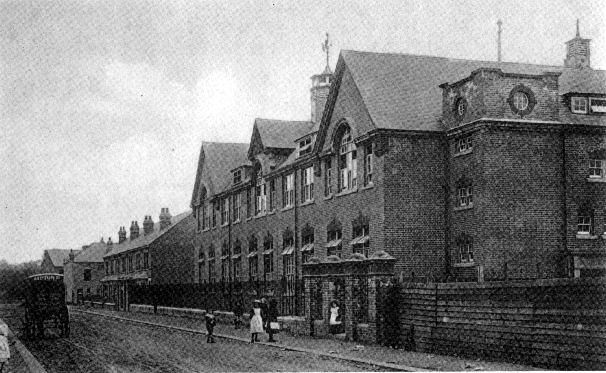 Four more schools became necessary. On January 14th, 1904 Sir Ralph Littler, CB,
KC, officially opened Clifton Road School. It was very modern, built to hold 800
pupils. It cost £9,500, and was a two-
Four more schools became necessary. On January 14th, 1904 Sir Ralph Littler, CB,
KC, officially opened Clifton Road School. It was very modern, built to hold 800
pupils. It cost £9,500, and was a two-
An adjacent school -
Over the years many changes have taken place — it became a Special Backward School at one time and in 1980 became a Special Language School. Caretaker — Mr Shaw.
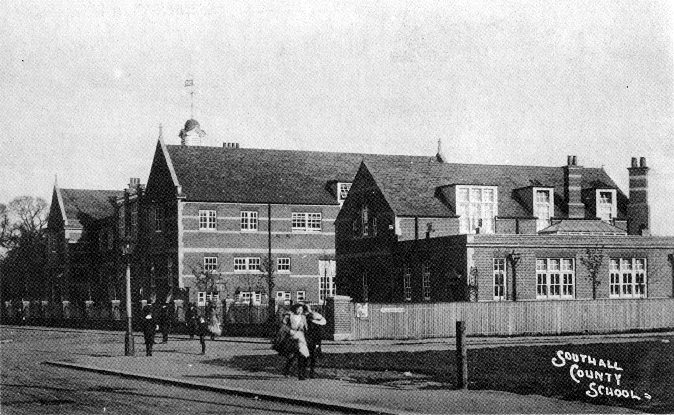 Southall County School (Villers), Boyd Avenue, was built in 1906-
Tudor Road School was built in 1906-
In 1904 the old White Swan, which was at the end of Pluckington Place, closed down and licence transferred to the present White Swan which had been built at the junction of Adelaide and Norwood Road, taking the place of two small cottages and a blacksmith's. The brothers A. & G. Stanley were licensees. They had a great reputation as cyclists and one of them used to ride a penny farthing bicycle. A bowling green was constructed at the side, where the Southall Bowling Club used to play.
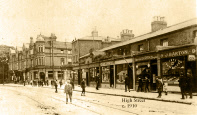
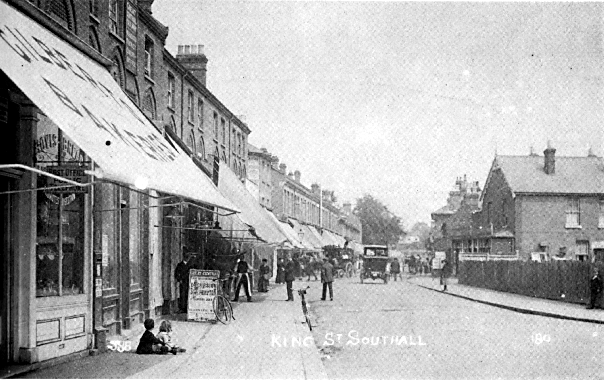 In 1903 eight very well built shops came into being on the right hand side of King
Street between Dagmar Road and Pluckington Place. The leases were granted so that
only one type of trade was carried on per shop. Thus, Quinions (Furnishers), Simmons
(Confectioners), Owen Barnetts (Fruiterer), Hoopers (Butcher), King and Hutchings
(Gazette Office and Stationers), Keevils (Hosier), Heaths (Bakers) with a bakery
at the rear. Except for a few years the King Street Sub Post Office has been in this
block of shops.
In 1903 eight very well built shops came into being on the right hand side of King
Street between Dagmar Road and Pluckington Place. The leases were granted so that
only one type of trade was carried on per shop. Thus, Quinions (Furnishers), Simmons
(Confectioners), Owen Barnetts (Fruiterer), Hoopers (Butcher), King and Hutchings
(Gazette Office and Stationers), Keevils (Hosier), Heaths (Bakers) with a bakery
at the rear. Except for a few years the King Street Sub Post Office has been in this
block of shops.
Beverley House on the left hand side, next to the Black Dog, was built for Mr Ben Hanson. Just inside Hammond Road, on the right hand side, a small Gospel Hall was built in 1901. The area of Hammond Road had been brickfields. When housing development commenced the standard of building was very poor.
Between 1902 and 1905 a great change took place in the Uxbridge Road. Old Leggatt's
Smithy and cottage were demolished; South Road widened and what still is the best
block of shops erected 1904-
The other shops were first occupied by United Dairies, Home and Colonial Stores, Hallam (Corn Chandler), Drug Stores, Pridous (Stationers), Hutchings (Butcher), Shellshears (Ironmongers), Haddrells (Furnishers). In 1902 three shops were built on the right hand side between Lady Margaret Road and Greenford Avenue. These became Evans (Paper, Tob.), Fletchers (Butcher) and Talbots (Off Licence). These were to be followed in 1903 with three larger shops on the corner of Lady Margaret Road. The corner one was Francis Waklings (Estate Office) with Rustons (Solicitors) and Blowers (Dentist) above. Another block of nine shops were built on the right hand side between Northcote Avenue and Saxon Road. The first of these was a Bakers with bakehouse at rear and the last, the Standard Wallpaper Company. For a good number of years tenants in the others came and went frequently.
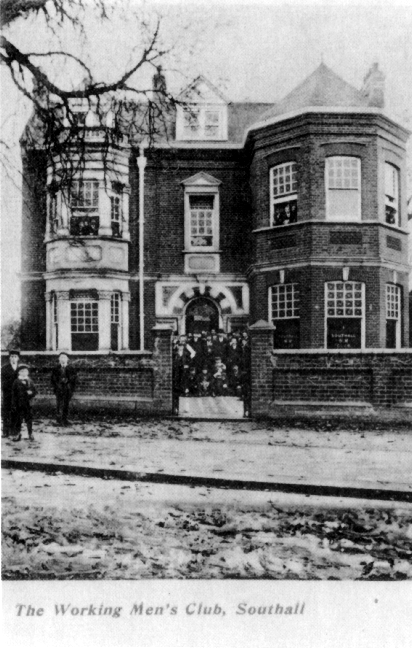 Over The Green things were also moving. On 8th September, 1906 the Working Men's
Club moved into the Chestnuts, with 350 members. The Southall Norwood Public Library
was built on the left hand side of. Osterley Park Road, on land given by Messrs Baxter
and Gosney, at a cost of £4,000. The gift of the Andrew Carnegie Trust. The foundation
stone was laid by Lady Jersey and the opening was 26th July, 1905 by James Bigwood,
Esq., MP Chairman of Library Committee, Mr G. Gosney. Books numbered 2,338, Librarian
Mr W. L. Coltman.
Over The Green things were also moving. On 8th September, 1906 the Working Men's
Club moved into the Chestnuts, with 350 members. The Southall Norwood Public Library
was built on the left hand side of. Osterley Park Road, on land given by Messrs Baxter
and Gosney, at a cost of £4,000. The gift of the Andrew Carnegie Trust. The foundation
stone was laid by Lady Jersey and the opening was 26th July, 1905 by James Bigwood,
Esq., MP Chairman of Library Committee, Mr G. Gosney. Books numbered 2,338, Librarian
Mr W. L. Coltman.
Two shops which stand out quite differently from all the others on the right hand
side of King Street were built in 1901. One was a bank -
At the corner of Waltham Road and Western Road was a small house and pig farm. The owner got into financial trouble and Mr Gosney purchased the mortgage. Part of the land is where the Baptist Church now is, and in 1908 Dudley MacDonald purchased the rest for £545. Belmont House was built in 1909 by Mr Peter Bell and, after being occupied for a year or two by Dr Vergo, became the Residence of Dr C. W. Seccombe in 1916, and the practice was carried on in the family name until 1981 when the house was sold to become an Elderly Asian Rest Centre.
In 1900 the Southall Volunteer Fire Brigade was formed, Mr C. N. Abbott being the
first officer. They had a very primitive hand-
Holy Trinity Hall, Lady Margaret Road, was built by C. Brown in 1905. It was always in demand for social events, it being the only hall available at the time. Holy Trinity Men's Club used the upstairs rooms. Alas, in 1982 the hall has been sold to our Asian friends who must have had a lot of work to do to it for it was in a very bad state due to lack of repairs.
St George's Church was built in 1905-
Mr S. W. Abbott had a nice house built on the left hand side of Uxbridge Road (The Chestnuts) in 1904; and Vine Cottage in Park View Road became, for a period, a Nursing Home and, later, the residence of Mr Bleckfeldt, the Chief Chemist of Otto Monsteds. Also built about the same time, another nice house 'Melrose' for Mr Paton, retired Headmaster of Marylebone School.
At the rear of land bought in August 1904 by the Methodists, on the right hand side
of South Road, Sunday-
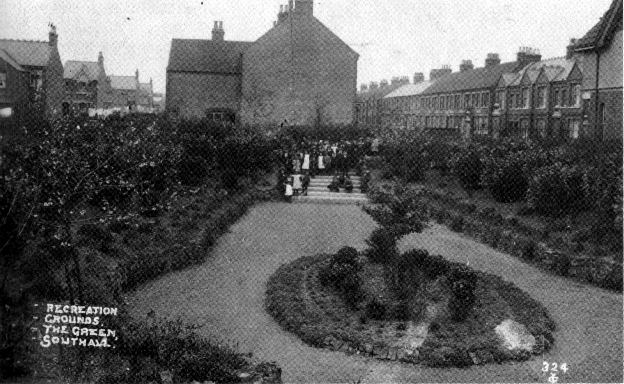 The provision of a park or recreation ground was a major item on the early Council's
programme. In 1902 Mr Baxter offered 12 acres at £325 per On the Steam Field Estate.
This would be where Scotts and Balfour Road are now. The offer was not accepted.
The present Recreation Ground, formerly known as Bills Charity Land, was bought in
1902 and came into use in 1903 The Lodge was built and Mr Harman appointed as Keeper.
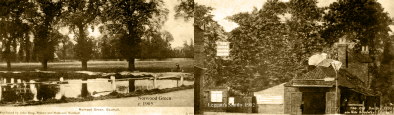
In 1909 Southall Council purchased Southall Park. This had been the scene of the
tragic fire and was originally Shepherds Haw, residence of Mr Merrick, covering 26
acres. The Lodge was built and Mr W. Perkins appointed as Park Keeper. Later a bandstand
was erected and sited on the right hand side of the main path at the rear of the
Red Lion. In 1910 another field of about 3 acres was added on to the east side which
brought the park to where Green Drive is today. The Uxbridge Road frontage had nice
looking iron railings with entrance gates. Alas, these had to be sacrificed during
the Second World War. There are also entrance gates at Boyd Avenue. There was a clear
view of the railway from the park and, on 12th May, 1910, a fair number of local
people gathered to watch the train bearing the coffin of King Edward VII to Windsor.
On the Coronation Day of King George V and Queen Mary, the Council provided a children's
party in the park. This was on the 22nd June, 1911. After games and a good tea, each
child received a medal to commemorate the event.
The provision of a park or recreation ground was a major item on the early Council's
programme. In 1902 Mr Baxter offered 12 acres at £325 per On the Steam Field Estate.
This would be where Scotts and Balfour Road are now. The offer was not accepted.
The present Recreation Ground, formerly known as Bills Charity Land, was bought in
1902 and came into use in 1903 The Lodge was built and Mr Harman appointed as Keeper.
In 1909 Southall Council purchased Southall Park. This had been the scene of the
tragic fire and was originally Shepherds Haw, residence of Mr Merrick, covering 26
acres. The Lodge was built and Mr W. Perkins appointed as Park Keeper. Later a bandstand
was erected and sited on the right hand side of the main path at the rear of the
Red Lion. In 1910 another field of about 3 acres was added on to the east side which
brought the park to where Green Drive is today. The Uxbridge Road frontage had nice
looking iron railings with entrance gates. Alas, these had to be sacrificed during
the Second World War. There are also entrance gates at Boyd Avenue. There was a clear
view of the railway from the park and, on 12th May, 1910, a fair number of local
people gathered to watch the train bearing the coffin of King Edward VII to Windsor.
On the Coronation Day of King George V and Queen Mary, the Council provided a children's
party in the park. This was on the 22nd June, 1911. After games and a good tea, each
child received a medal to commemorate the event.
There were two football clubs in 1905-
By this time another Southall farm had been swallowed up (Southall Green Farm), also
Emfield House had been demolished, and Church Avenue made. Elmfield Market and four
shops between The Victory on its left hand side -
Mr R. W. Baxter had 'South Lodge' built. This is where St Anselm's Church is now
and it faced south -
Hortus House had been pulled down and Hortus Road made. It is a cul-
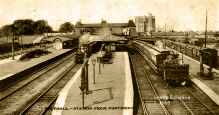
On the left hand side of the station a road leading down to the Goods Depot became the Coal Wharf. A siding had been constructed and coal trucks unloaded. There were several Coal Merchants — Barnes Brothers are the oldest established and are still in business in Regina Road. Others were Belcher and Gibbons, Balltrops, Cornwalls, Lillishalls, Whitehouse. Most had small order offices at the side of the road.